25Nov, 2026
Understanding Surrogacy - A Complete Guide To The Process, Ethics And Modern Legal Landscape
Parenthood is a personal journey and for individuals and couples facing any medical barriers to carrying pregnancy, surrogacy offers a path forward. Over the past decade, advancements in reproductive medicine – paired with major shifts in Indian legislation – have reshaped how surrogacy works.
WHAT IS SURROGACY?
The word "Surrogate" is rooted in Latin "Subrogare", which means "appointed in place of".
According to ART Bill 2014, "Surrogacy" means an arrangement in which a woman agrees to a pregnancy, achieved through assisted reproductive technology (ART), in which neither of the gametes (egg or sperm) belongs to her or her husband, with the intention to carry it and hand over the child to commissioning couple for whom she is acting as surrogate.
HISTORY
1st surrogacy arrangement, according to the Old Testament of the Bible, has happened about 2,000 years before the birth of Christ.
Sarah and Abraham hired a maid Hagar to carry their child, Ishmael.
In Hindu Mythology, Lord Krishna's elder brother, Balaram regarded as the son of mother Devaki despite taking birth from the womb of Rohini.
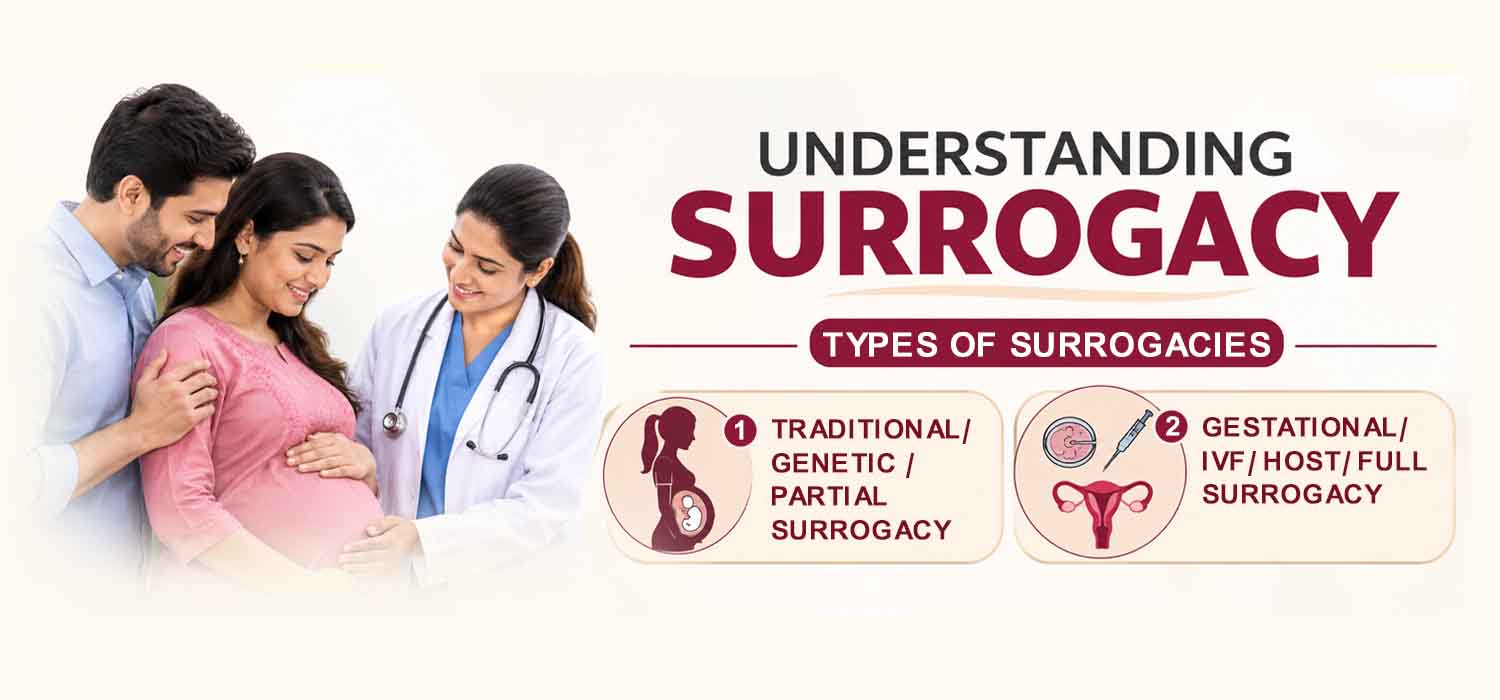
TYPES OF SURROGACIES
- TRADITIONAL / GENETIC / PARTIAL SURROGACY
Result of artificial insemination of the surrogate mother with the intended father's sperm, making her the genetic parent along with the intended father.
Due to legal and emotional considerations, it is rarely practised & prohibited. - GESTATIONAL / IN-VITRO FERTILISATION (IVF) / HOST / FULL SURROGACY
- Is an arrangement in which an embryo from the intended parents, or from a donated oocyte/sperm is transferred to a surrogate mother's uterus.
- Hence the surrogate has no genetic connection to the child.
Based on the compensation structure – surrogacy is classified as COMMERCIAL AND ALTRUISTIC.
COMMERCIAL / COMPENSATED SURROGACY – Is paid for her medical costs and living expenses for carrying the pregnancy.
ALTRUISTIC SURROGACY – Surrogate is reimbursed for medical costs related to pregnancy and loss of income due to pregnancy.
WHO NEEDS SURROGACY?
- Absence of a functioning uterus
- Congenital – MRKH syndrome.
- Acquired – Hysterectomy for various reasons.
- Significant uterine structural abnormalities – like multiple fibroids.
- Severe adenomyosis.
- Persistently thin endometrium – due to endometrial TB.
- Asherman's syndrome.
- Repeated miscarriage & unexplained IVF failures despite good quality embryos.
- Any medical condition that may be life threatening during pregnancy.
- Biological inability – Eg – same sex couple / single men.
Technicalities & the Modern Legal Landscape of Surrogacy
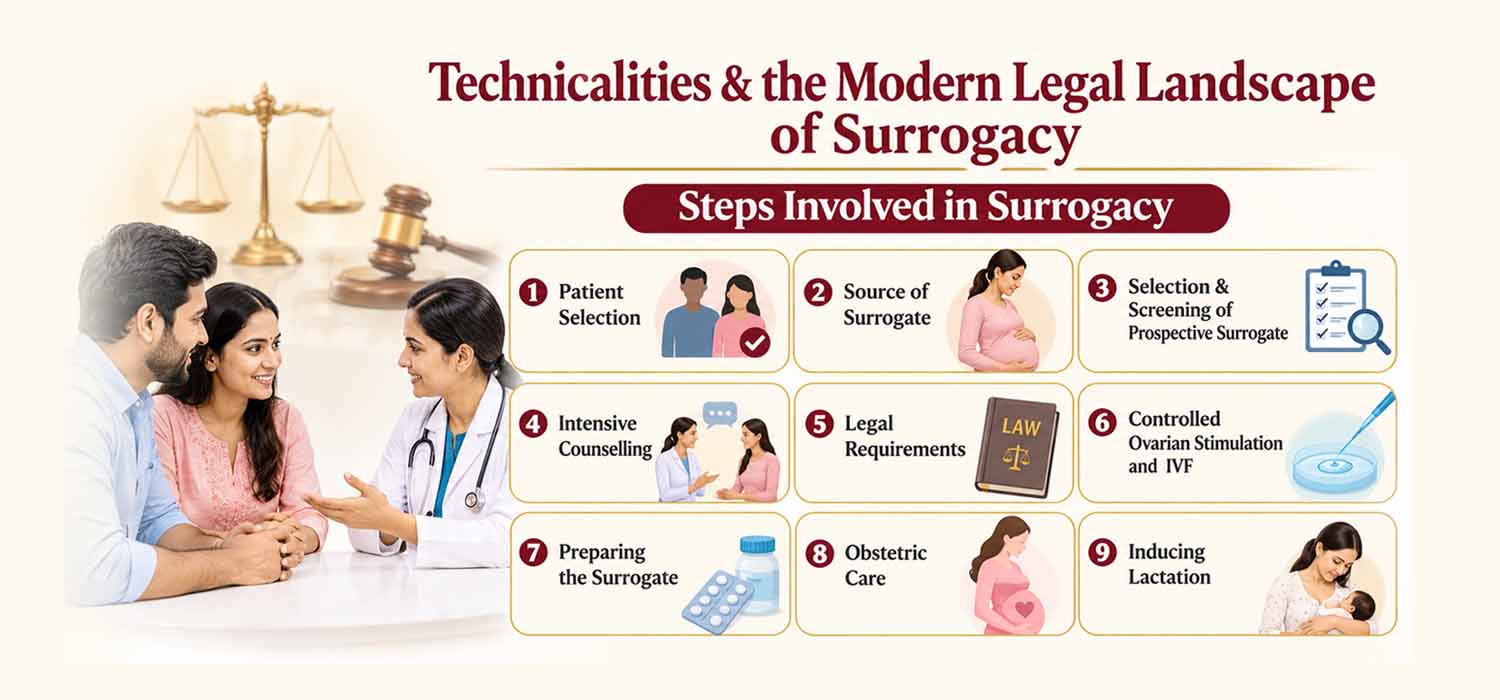
Steps Involved in Surrogacy
- PATIENT SELECTION
- Only with medical indication.
- SOURCE OF SURROGATE
- Selected from the National Registry of Assisted Reproductive Technology (ART) Banks in India of the Indian Council of Medical Research (ICMR).
- A woman from the family or a known person to the couple may act as a surrogate mother.
- SELECTION & SCREENING OF PROSPECTIVE SURROGATE
- Surrogate:
- Age: 21–35 years.
- Must be married.
- Must have one child of her own, with a minimum age of 3 years.
- Consent of the surrogate's spouse is mandatory.
- Extensive medical and psychological assessment and thorough criminal background check.
- Routine tests to determine the general health of the surrogate.
- Uterus evaluation, such as hysteroscopy.
- Medical fitness certificate from a physician.
- Surrogate:
- INTENSIVE COUNSELLING
- For the Genetic Couple:
- Alternative treatment options.
- Detailed counselling.
- Cost of surrogacy.
- Psychological risks of surrogacy.
- Psychological risks to the child.
- Possibility of:
- Multiple pregnancy.
- Birth of an abnormal child.
- Legal advice.
- For the Surrogate:
- Details of the undergoing IVF procedure.
- Possibility of multiple pregnancy.
- Family and friends being against such treatment.
- Risks associated with pregnancy.
- Possibility of C-section.
- For the Genetic Couple:
- LEGAL REQUIREMENTS
- A. CERTIFICATE OF ESSENTIALITY
- Obtained from the District Medical Board.
- Official confirmation of medical indication requiring gestational surrogacy (and donor gametes, wherever medically indicated).
- Magistrate Court order regarding parentage and custody of the child to be born through surrogacy.
- Surrogate insurance for 36 months, covering pregnancy, delivery and postpartum complications.
- B. CERTIFICATE OF ELIGIBILITY
An official document issued by the appropriate authority confirming that the following requirements are met:- Intending Couple:
- Wife: 23–50 years.
- Husband: 26–55 years.
- Must have no surviving child.
- Must have a certified medical condition indicating the need for surrogacy.
- Intending Woman:
- Indian widow or divorcee.
- Age: 35–45 years.
- Surrogate Mother:
- Age: 25–35 years.
- Mandatory Insurance Coverage
- Insurance coverage for the health of the surrogate mother for 36 months, covering pregnancy, delivery and postpartum complications.
- Violations and Penalties
- Any violations, such as commercial surrogacy, advertising or exploiting a surrogate mother, carry penalties.
- Imprisonment of up to 10 years and a fine of up to ₹10 lakh.
- A. CERTIFICATE OF ESSENTIALITY
- Controlled Ovarian Stimulation and IVF
- Proper controlled ovarian stimulation and IVF for the intending woman for oocyte retrieval.
- Preparing the Surrogate
- Preparing the surrogate for embryo transfer.
- Obstetric Care
- Obstetric care of the surrogate mother.
- Inducing Lactation
- Inducing lactation in the genetic mother.
Interested to know more about this? Our certificate course in reproductive medicine program consists of comprehensive curriculum inclusive of all key steps involved in surrogacy and more.