
05Nov, 2026
Third-party reproduction: Navigating donor eggs, donor sperm & surrogacy with confidence
Third-party reproduction refers to an Assisted Reproductive Technology process in which a third individual provides genetic material like oocyte and sperm or carries a pregnancy to help intended parents conceive a child.
First such conception was reported after transplanting an unhatched embryo flushed out from the donor by uterine lavage, using a special device into the recipient uterus. When assisted reproduction was introduced into medical practice in the last part of the 20th century, it wasn't easily accepted by a few religious groups. Today, this process is mostly accepted by all groups.
Oocyte donation is used to achieve pregnancy in women with premature and age-related ovarian failure, poor ovarian reserve, Turner’s syndrome, recurrent implantation failure or recurrent abortions due to poor oocyte quality.
Donor semen insemination is used for male partners suffering from azoospermia or severe oligoasthenospermia.
Such donor gametes are opted by couples to avoid transmission of severe genetic diseases.
Gamete donation rules as per ART regulation act 2021
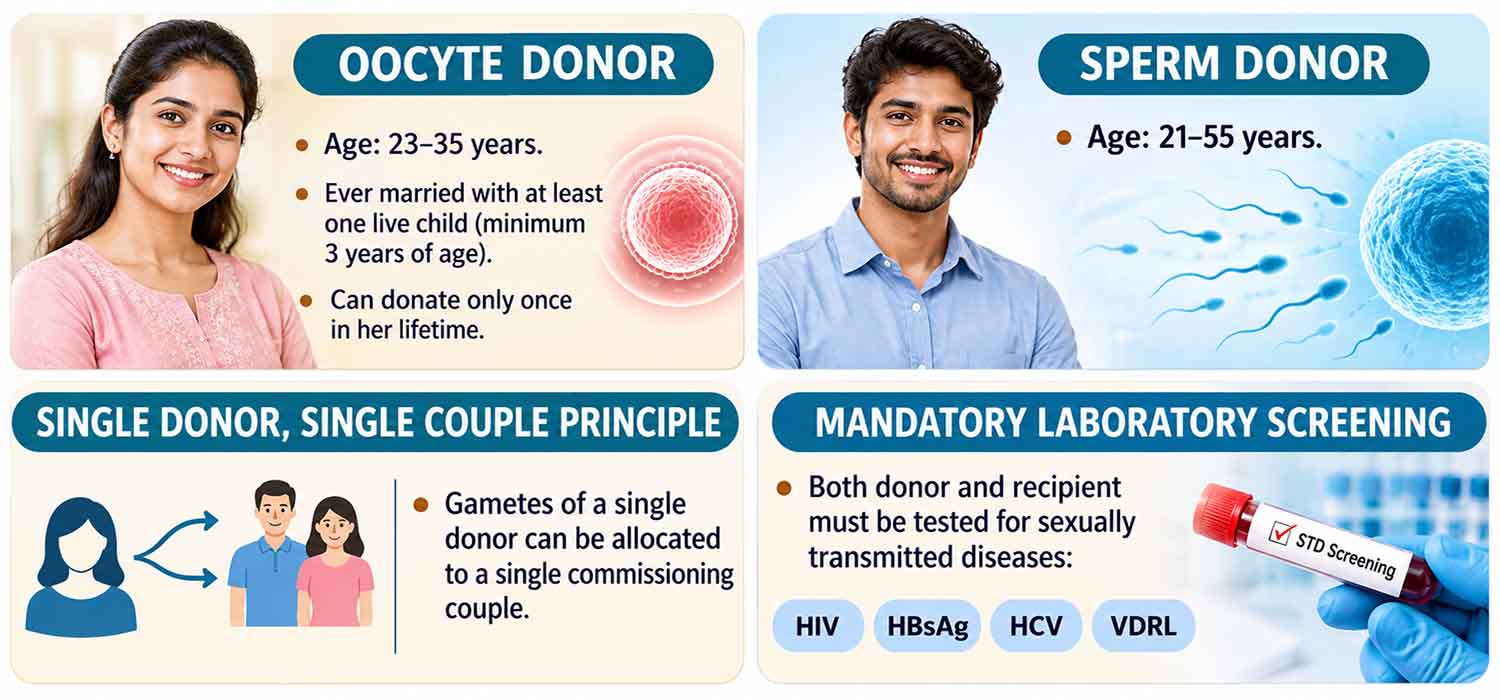
| Category / Principle | Details |
|---|---|
| 1. Oocyte Donor |
- Age: 23–35 years. - Ever married with at least one live child (minimum 3 years of age). - Can donate only once in her lifetime. |
| 2. Sperm Donor | - Age: 21–55 years. |
| 3. Single Donor, Single Couple Principle | - Gametes of a single donor can be allocated to a single commissioning couple. |
| 4. Mandatory Laboratory Screening |
Both donor and recipient must be tested for sexually transmitted diseases: - HIV - HBsAg - HCV - VDRL |
- Storage Limits: Unused gametes and embryos can be cryopreserved for a maximum period of 5 years.
- Recipient Information: The recipient is entitled to know about the physical characteristics, ethnicity, educational background, and relevant medical and family history of the donor.
- Insurance Cover: Insurance cover should be provided to the oocyte donor by the commissioning couple.
- Legal Rights of the Child: The child born through ART shall be deemed to be the biological child of the commissioning couple, and the child is entitled to all rights and privileges available to a natural child only from the commissioning couple under law.
Certain programs, such as a Fellowship in Reproductive Medicine in India, can make a substantial contribution in promoting research in the Third-Party Reproduction. By getting a thorough understanding of third party reproduction, which includes donor eggs, donor sperm and surrogate mother, the programs give healthcare practitioners the skills needed to help patients make difficult choices regarding their infertility treatment with full knowledge and confidence.