31Jan, 2026
Ovarian Rejuvenation: A New Ray of Hope in Fertility Treatment
Introduction
Motherhood is a deeply cherished aspiration for many women, often associated with emotional fulfillment, social expectations, and personal identity. However, for a growing number of women, conceiving naturally becomes challenging due to medical conditions such as premature ovarian insufficiency (POI), diminished ovarian reserve, repeated IVF failures, or age-related decline in fertility. These challenges can be emotionally distressing and may lead many women to believe that their only remaining option is donor egg IVF.
With rapid advances in reproductive medicine, newer treatment approaches are being explored to expand fertility options. One such emerging innovation is ovarian rejuvenation. This advanced fertility treatment aims to reactivate a woman’s own ovarian potential, offering renewed hope to those who were previously told that biological motherhood might not be possible. While ovarian rejuvenation is still under scientific evaluation, early clinical experiences have shown promising outcomes in carefully selected patients.
Understanding Ovarian Aging and Ovarian Reserve
A woman is born with a finite number of eggs, known as her ovarian reserve. Over time, both the quantity and quality of these eggs decline naturally. Factors such as genetics, autoimmune conditions, chemotherapy, radiation therapy, smoking, severe stress, and environmental toxins can accelerate this decline.
Ovarian reserve is commonly assessed using markers such as Anti-Müllerian Hormone (AMH), antral follicle count (AFC), and follicle-stimulating hormone (FSH) levels. Low AMH and poor response to ovarian stimulation often indicate reduced fertility potential. Traditionally, women with significantly diminished ovarian reserve were advised to proceed with donor egg programs. Ovarian rejuvenation seeks to challenge this paradigm by attempting to stimulate residual ovarian tissue and dormant follicles.
What is Ovarian Rejuvenation?
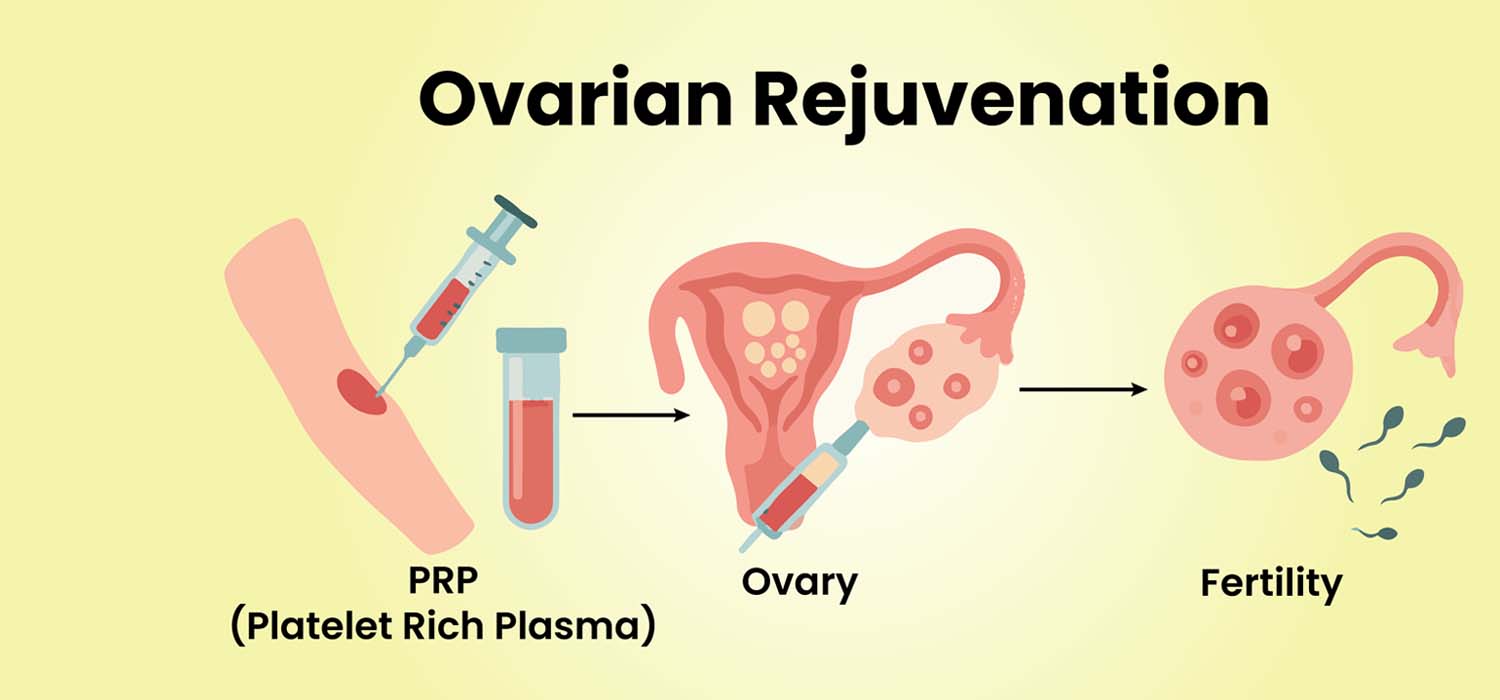
Ovarian rejuvenation is an advanced fertility-enhancing procedure designed to stimulate ovarian tissue and potentially improve ovarian function. The most commonly practiced technique today involves Platelet-Rich Plasma (PRP) therapy. PRP is derived from the patient’s own blood and contains high concentrations of growth factors, cytokines, and bioactive proteins.
Once prepared, PRP is injected directly into the ovarian tissue under ultrasound guidance. These growth factors are believed to enhance blood supply, improve cellular repair mechanisms, and activate dormant follicles. Experimental stem cell–based ovarian rejuvenation techniques are also being studied but are currently limited to research settings and are not part of routine clinical practice.
Who Can Benefit from Ovarian Rejuvenation?
Ovarian rejuvenation is not suitable for all women but may be considered in selected cases. Potential candidates include women with low AMH levels, poor ovarian response in previous IVF cycles, premature ovarian insufficiency, early menopause, or advanced maternal age who strongly wish to conceive using their own eggs.
Women who have undergone chemotherapy or radiation therapy may also be evaluated on a case-by-case basis. Thorough fertility assessment, realistic counselling, and individualized treatment planning are essential before recommending this therapy.
Procedure Overview
The ovarian rejuvenation procedure typically begins with drawing a small amount of the patient’s blood. This blood is processed using specialized centrifugation techniques to separate platelet-rich plasma. Under transvaginal ultrasound guidance, PRP is carefully injected into one or both ovaries using a fine needle.
The procedure is minimally invasive, usually performed as a day-care procedure, and does not require general anesthesia in most cases. Patients are observed briefly and discharged the same day. Mild pelvic discomfort may occur, but serious complications are rare. Most women can return to their routine activities within 24 hours.
Scientific Evidence and Current Research
Several preliminary studies and observational reports have suggested that ovarian PRP therapy may improve ovarian function in selected women. Some women with premature ovarian insufficiency have reported resumption of menstrual cycles, improved hormone profiles, and increased response to ovarian stimulation.
In IVF settings, ovarian rejuvenation has been explored as an adjunct therapy to enhance follicular response and egg quality. However, it is important to note that large-scale randomized controlled trials are still ongoing. Long-term safety, optimal protocols, and patient selection criteria are areas of active research.
Advantages of Ovarian Rejuvenation
One of the most significant advantages of ovarian rejuvenation is that it uses the patient’s own blood, eliminating the risk of allergic reactions or immune rejection. The procedure is minimally invasive and can be combined with assisted reproductive techniques such as IVF or ICSI.
For some women, ovarian rejuvenation may delay the need for donor eggs or allow them to attempt conception with their own genetic material. It also provides psychological reassurance by offering an additional option when conventional treatments have failed.
Limitations and Ethical Considerations
Despite its promise, ovarian rejuvenation is not a guaranteed solution. Success rates vary widely depending on age, baseline ovarian reserve, and underlying medical conditions. Women with completely depleted ovarian tissue may not benefit from this treatment.
Ethical practice requires transparent counselling regarding realistic expectations, costs, and potential outcomes. Patients must understand that ovarian rejuvenation is an evolving therapy and should be considered experimental in many contexts.
Role of Ovarian Rejuvenation in IVF Treatment
Ovarian rejuvenation is increasingly being explored as a preparatory or adjunct step before IVF cycles in poor responders. By potentially improving follicular recruitment and ovarian responsiveness, it may enhance IVF outcomes in selected patients.
Fertility specialists carefully evaluate timing between PRP injection and ovarian stimulation to maximize potential benefits. However, treatment protocols vary, and personalized planning is essential.
Conclusion
Ovarian rejuvenation represents an exciting advancement in fertility care, expanding reproductive possibilities for women who once had very limited options. While it is not a universal solution, it has opened new avenues of hope in reproductive medicine.
At Dr. Kamini Rao Hospitals, we remain committed to offering evidence-based, ethical, and individualized fertility treatments. Women considering ovarian rejuvenation are encouraged to consult experienced fertility specialists to determine whether this therapy aligns with their reproductive goals and medical profile.